


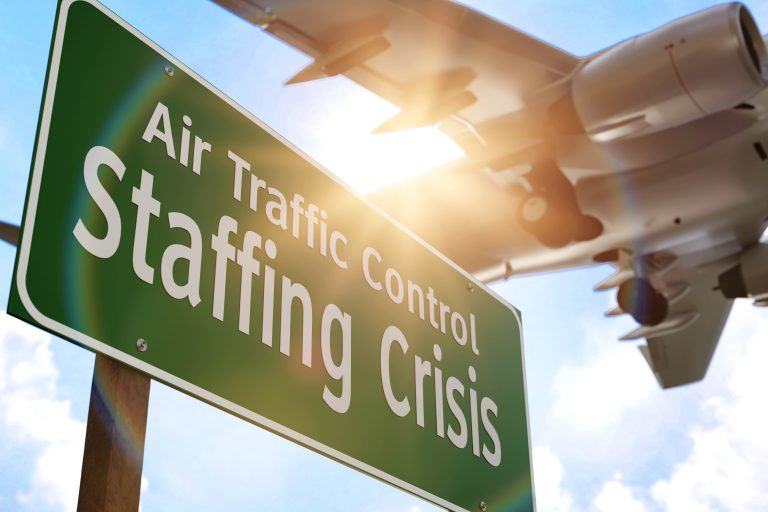
The Federal Aviation Administration has announced its plans to launch a new air traffic control workforce plan meant to ease pressure on the industry caused by a long-standing staffing shortage. The new plan focuses on three central goals: modernizing the National Airspace System, expanding the agency’s aggressive hiring, and optimizing controller efficiency.
According to the FAA’s official site, the agency hopes to have fully implemented a new air traffic control system by the end of 2028. In collaboration with the Department of Transportation and technology and security company Peraton, the FAA hopes to oversee a total overhaul of the current system.
The changes will reportedly reduce airspace complexity by deconflicting airline scheduling to smooth out traffic flow; expand advanced simulator-based training; and use AI and machine learning tools to simulate and manage airspace performance prior to departures, as per Travel Pulse.
The national air traffic control system makeover will also include updated equipment. This means the national system will implement over 27,000 new radios, 462 new digital voice switches, 612 state-of-the-art radars, and over 5,000 new high speed network connections of fiber, satellite and wireless.
This will be the first broad update to the national system since the 1960s when the commercial air industry was picking up steam in American life. “We can’t continue to operate the same way and expect better results,” said FAA Administrator Bryan Bedford. “We’re changing how we hire, train, and schedule our controller workforce — and providing them with the state-of-the-art tools they need to succeed.”
Click here to apply to become an Air Traffic Controller.
